Articles
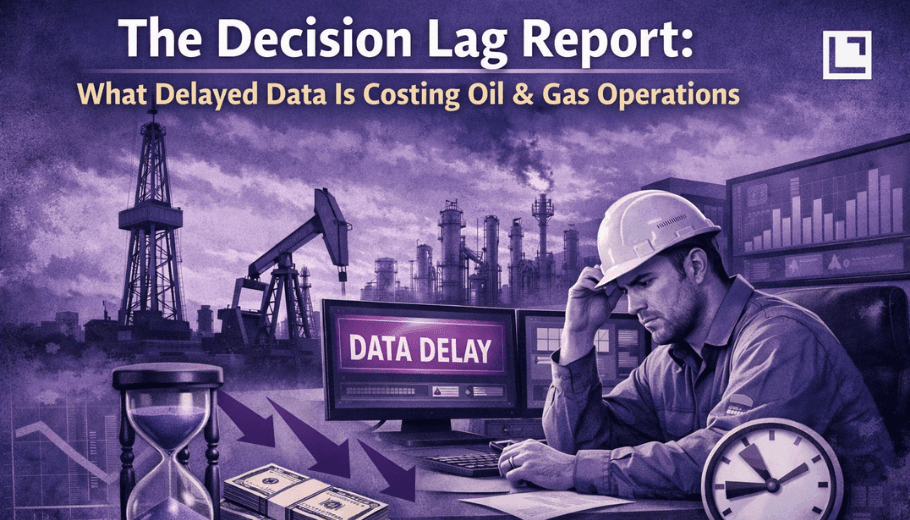
March 16, 2026 | data²
Picture the scene…
It's Monday morning. Your leadership team is in the room. Someone asks a straightforward question about production performance across your key assets last week.
The answer doesn't exist yet.
Not because no one collected the data. Your SCADA systems collected it. Your ERP touched parts of it. Your field teams logged it manually where the systems didn't reach.
The data exits. It's just sitting in seven different places, in seven different formats, owned by seven different teams, none of whom were expecting this question on a Monday morning.
So someone goes to build the report. Which will take until, at least, Wednesday to complete.
By the time it lands, it will reflect a reality that has already moved on. The wells it describes have changed. The equipment it references has either been serviced or hasn't. The production numbers it contains are history, not intelligence.
And somewhere in the gap between what happened and when your team found out, a decision was made without the full picture.
This is not a story about one company. This is the operational reality of most oil and gas organizations in 2026.
And it has a name: decision lag.
What Decision Lag Actually Is
Decision lag is the distance between when something happens in your operation and when the right person has the information to act on it.
It is not a new problem. But it is a worsening one.
As operations have grown more complex (more assets, more geographies, more data sources, more systems) the distance between event and awareness has stretched. The average oil and gas operator today reconciles data from somewhere between seven and twelve separate systems to produce a single performance report.
Each system was built for its own purpose. Each speaks its own language. None of them were designed with the assumption that a VP of Operations would one day need a unified, real-time view across all them before a Monday morning meeting.
So the data piles up. The reports lag behind. And decisions get made on information that is already outdated by the time it arrives.
Where It Costs You Most
In the Field: Before the Failure Happens
Seventy-two percent of unplanned downtime events in oil and gas companies have detectable precursor data already sitting in existing systems before the failure occurs.
Read that again. The warning was there. The sensors captured it. The data was stored. But the infrastructure to surface it, connect it, and get it to the right engineer before the failure cascaded didn't exist.
The average unplanned downtime event costs somewhere between $250,000 and $1.5 million when you account for lost production, emergency maintenance premiums, expedited logistics, and the downstream disruption that follows.
For most operators, that's not one event per year. It's a recurring line item on the P&L, one that could be dramatically smaller if the gap between data collection and action taken were measured in minutes rather than days.
In the Boardroom: When Capital Gets Allocated
Capital allocation decisions (which assets get investment, which get optimized, which get divested) are the highest stakes calls an executive team makes.
They are also, in most organizations, decisions made on a picture of asset performance that is weeks or months old by the time it reaches the table.
The consequence is not always visible. Capital flows toward assets that looked strong at the last planning cycle. Opportunities that have emerged since are invisible. Under performers that have deteriorated since the last review continue to attract investment.
A recent analysis found that operators with real-time asset performance visibility allocated capital with 23% greater efficiency than peers working from periodic reporting cycles.
That gap doesn't come from smarter people, better strategy, or general use of AI. It comes from a connected data ecosystem versus fragmented, siloed data.
In the AI Initiative: Where Boards Are Placing Big Bets
This is the decision lag consequence that will define the next three years in oil and gas.
Every major operator has AI on the roadmap. Predictive maintenance. Production optimization. Anomaly detection. Digital twin development. The investment is real. The board expectations are high.
Here is what the AI vendors are not leading with:
A large operator recently deployed a predictive maintenance model across a critical asset class. The model was well-designed. The data science team was strong. The vendor had a proven track record.
Twelve hours before a significant equipment failure, the kind the model was specifically built to prevent, the model rated the equipment as healthy.
Not because the AI was wrong. But because the data feeding it was fragmented.
Fragmented systems, inconsistent data quality, multi-model data, and reporting delays don't disappear because a language model is sitting on top of them. They produce faster, more confident wrong answers.
The organizations that will realize the most value from AI in energy operations are not the ones deploying AI the fastest. They are the ones building the data foundation first, so that when AI sits on top of it, the results are reliable enough to act on.
The Numbers Behind the Problem
The Cost of Decision Lag | |
|---|---|
Average reporting lag for operational data | 24 to 72 hours In an industry where conditions change by the hour, this is not a reporting delay. It's a decision delay. |
Time spent building a standard performance report | 6 to 14 hours That's your most capable people doing data preparation instead of analysis. |
Data sources reconciled manually per report | 7 to 12 systems Each one a potential point of error. Each one adding hours to the process. |
Production efficiency loss from reactive decision-making | 2 to 4% At scale, this is not a rounding error. It is one of the largest controllable cost items in the business. |
Unplanned downtime events with detectable precursor data already in systems | 72% The warning was there. The infrastructure to act on it wasn't. |
Why Heavy Technology Investment Hasn't Fixed It
The question every technology leader in oil and gas eventually asks themselves:
We have spent significantly on data infrastructure. Why is this still a problem?
Three reasons:
The systems were built to record. Not to connect.
SCADA systems were designed to monitor and control equipment. Historians were designed to store time-series data. ERP platforms were designed to manage business processes. Each was built by a different vendor, in a different era, for a different purpose. None of them built to talk to each other. Getting them to produce a unified, real-time picture of operational performance was never part of the design brief. That problem was left for the data team to solve manually, repeatedly, and indefinitely.
The data team is solving the wrong problem.
The most consistent finding across oil and gas data organizations: between 60 and 80 percent of data team capacity goes to data preparation: building pipelines, reconciling schemas, cleaning inconsistent inputs, maintaining the infrastructure that keeps data moving. What's left for actual analysis, for generating the insights that drive decisions, is whatever remains. Which is rarely enough.
Digital transformation is moving faster than the foundation beneath it.
The pressure to deploy AI, automate operations, and digitize workflows is real and accelerating. Budgets have been approved. Roadmaps have been published. Board commitments have been made. But in the urgency to deploy the next layer of capability, one question is consistently underweighted: Is the data this initiative depends on clean, connected, and current enough to make it work? In most organizations, the honest answer is: not yet.
What Closing the Gap Actually Looks Like
The operators making the most progress on decision lag share a common approach.
Rather than continuing to layer new technology on top of fragmented data infrastructure, and hoping the results improve, they invest first in the foundation. A unified, real-time data environment that connects every source, every system, and every asset into a single, current picture of the operation.
The results are consistent:
Reporting time measured in minutes, not days
Equipment failures predicted before they happen
Capital allocation decisions made on current asset performance
AI initiatives that deliver on their promise because the data is structured in a way where AI can reason across it
One version of the truth that every team, from the field to the boardroom, works from
The data to make this possible already exists inside your operation.
What closes the gap is connecting it.
This Is the Problem data² Was Built to Solve
data² is a unified decision intelligence platform built to help enterprise organizations get the most from their data.
We connect the systems you already have (SCADA, ERP, IoT sensors, financial platforms) into a single real-time environment. Your teams get current, reliable operational decision intelligence. Your AI initiatives get the connected data relationships they need to actually work. Your leadership gets one version of the truth, available now, not next week.
We're not a replacement for the infrastructure you've already built. We're a layer of clarity on top of it, connecting your structured, unstructured, and multi-modal data across your ecosystem. No rip-and-replace of systems needed and just weeks to deploy.
If decision lag is a problem you recognize in your organization, the next step is a conversation.
Last Posts

Podcasts
Edge AI Governance
Read More

Articles
data² Partners With Memgraph to Power Decision Intelligence
Read More
Articles
Decision Intelligence, Explained
Read More

Articles
Stop Revenue Leakage
Read More
©2026 Data Squared USA Inc. | All rights reserved | US Patent US012339839B2