Podcasts

Compute Is Moving To Where The Power Is. The Evidence Has To Move With It
September 8, 2026 | Sarah Wicker
The short version. Edge AI governance is the practice of keeping AI decisions traceable and defensible when inference runs across many distributed sites instead of one central facility. Moving compute to where power already exists solves the energy and capital bottleneck. It does not create a record of how any conclusion was reached. Both problems have to be solved together. Watch the full episode.
Most of the argument about AI infrastructure is an argument about real estate. Where the campus goes. Which utility can serve it. How many years of transmission buildout the ratepayers absorb before the first rack turns on.
That argument is real, and it is stalling. Traditional mega data centers carry three to five year lead times, billion dollar capital commitments, and 15 to 20 year power contracts. Communities are pushing back on water, cooling, and grid strain, and the backlash is bipartisan enough to kill projects outright. Meanwhile the demand curve does not wait. Goldman Sachs, cited in this episode, projects a 5,000 percent increase in compute demand over the next five years.
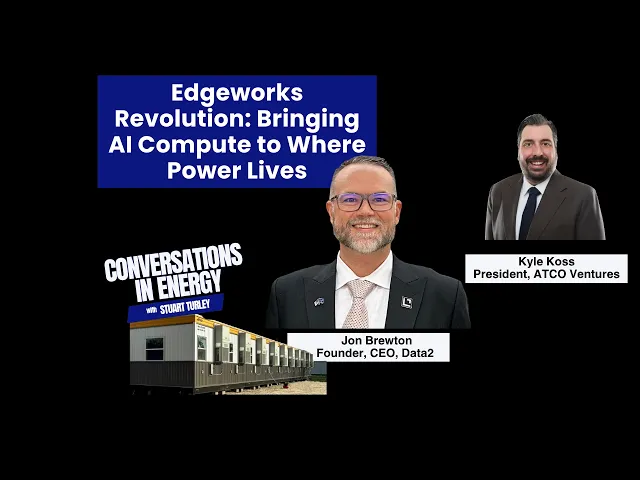
On the Energy News Beat Podcast, host Stu Turley sat down with data² founder and CEO Jon Brewton and ATCO Ventures President Kyle Koss to work through the answer that is available now: stop moving power to compute, and start moving compute to power.
That solves a supply problem. It also creates a governance problem that almost nobody in this conversation is naming yet.

Why AI Compute Is Moving Closer To Power Generation
The constraint on AI is no longer model quality or silicon supply. It is interconnect queues, generation capacity, and the capital required to reserve both for two decades. Only a handful of companies can write that check.
ATCO Edgeworks is a modular edge data center platform built to sit next to generation that already exists, including natural gas, solar, and flared gas that operators are currently burning off. That is what makes distributed AI compute structurally different rather than merely cheaper. A modular unit at a wellsite or an industrial facility uses power already on site, scales up and down with actual demand, and carries no 20 year obligation.

In the episode, Koss makes the case for what that opens up. Mid-tier operators, the companies Turley calls the mom and pop side of oil and gas, get to run real AI workloads without a billion dollar commitment. Bitcoin mining sites already sitting on stranded power become AI capacity. Flared gas becomes compute instead of an emissions line item.
The community math changes too. Distributed load across smaller localized units puts less strain on any single grid node, uses less water in any single place, and does not require consumers to fund transmission lines built for a campus that may never reach full utilization. Data centers done right, as Turley puts it, look less like one enormous facility and more like many small ones sitting where the electrons already are.
What Distributed AI Compute Solves
Centralized mega data center | Edgeworks with data² inside | |
|---|---|---|
Time to first rack | 3 to 5 years | Months |
Capital commitment | Billions, plus 15 to 20 year power contracts | Incremental, matched to demand |
Power source | New generation and new transmission | Generation already on site, including flared gas |
Community impact | Concentrated water, cooling, and grid strain | Distributed across smaller localized load |
Access | A handful of companies that can fund it | Mid-tier operators and smaller organizations |
Decision traceability | Not solved, and harder at scale | Built into the stack |
Edge AI Governance Is The Gap Nobody Is Naming
When inference runs in one hyperscale facility, the output is at least centrally observable. When it runs in forty modular units across a basin, you have forty places generating conclusions that feed operational, financial, and regulatory decisions, and no inherent record of how any of those conclusions were reached.
That is not a theoretical exposure. It is the same fragmentation problem enterprises already have, moved closer to the asset and multiplied. An operator who acts on an edge inference and cannot reconstruct the basis for it has not gained speed. They have gained a liability with a faster clock on it.
This is the work data² does, and it is why Brewton was in that conversation rather than a hardware vendor. The reView platform connects data across the systems an organization already runs, validates every insight against trusted source data, and issues each finding as a Decision Record.
A Decision Record is a single artifact containing a conclusion, the evidence underneath it, and the traceable path back to every source record that supports it. It is what turns an AI output into something a person can defend to an auditor, a regulator, a joint venture partner, or opposing counsel. Patented hallucination-resistant reasoning means the platform declines rather than guesses when the evidence does not support a determination. Read-only access. Data stays where it is. No rip and replace. This is what decision intelligence is for, and it is a different discipline from generating an answer.
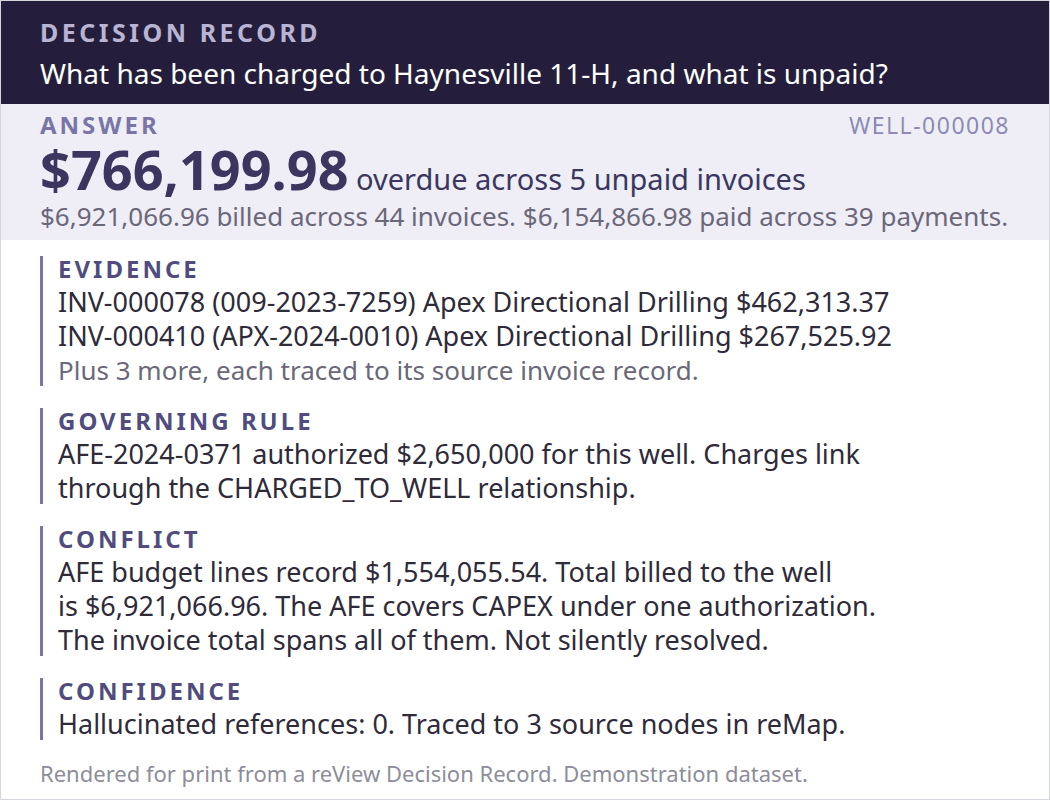
Brewton cites the case that makes the stakes concrete. On a single forensic engagement covering a $260 million capital program, reView read more than 4,500 invoices, change orders, time and materials reports, accounting records, and emails together in one place. It surfaced $98 million in fraud risk, $39 million of which was recovered, with every finding traced back to the record that proved it. That outcome is not available from a model that produces an answer without an evidence chain, however close to the power source it runs. The same approach runs across Financial Intelligence and the rest of the platform.
Why Energy And Defense Hit This Constraint First
Both sectors share a property that makes the evidence requirement non-negotiable. The cost of being wrong is not a bad quarter.
In energy, a finding gets tested by an auditor, a joint venture partner, a regulator, or opposing counsel. In defense, edge compute is a survivability requirement, since a centralized facility is a single target and a warfighter making a real-time decision cannot wait on a round trip to a distant campus. The episode covers both, including the data sovereignty and quantum-resistant encryption work that makes distributed deployment viable for government at all.
In each case the same two conditions have to hold at once. The compute has to be where the mission is. The reasoning has to be defensible after the fact. Speed without evidence is the failure mode we already measured in how long enterprises take to act on their own data, only faster.
Watch The Full Conversation
Brewton, Koss, and Turley get into the capital math, the community opposition question, the flared gas use case, military deployment, and where the trust layer sits in a distributed architecture.
Watch the full episode:
If you are deciding where AI compute belongs in your operation, the infrastructure question and the evidence question have to be answered together, and this episode is where both get asked.
Edge AI Governance: Common Questions
What is edge AI governance?
Edge AI governance is the practice of keeping AI decisions accurate, traceable, and defensible when inference runs across many distributed locations rather than one central facility. It covers how a conclusion was reached, which source data supports it, and whether that reasoning can be reproduced and defended later by an auditor or regulator.
Why is AI compute moving closer to power generation?
Power, not chips, is now the binding constraint on AI. New centralized capacity requires interconnect queues, three to five year build timelines, and 15 to 20 year power contracts. Modular edge data centers placed next to existing generation, including natural gas, solar, and flared gas, avoid all three and can be deployed in months.
Does distributed AI compute make AI harder to audit?
Yes, without a governance layer. Distributing inference across many sites multiplies the number of places producing conclusions while creating no shared record of how they were produced. Traceability has to be built into the reasoning itself rather than added at the facility, because there is no longer a single facility to add it to.
What is a Decision Record?
A Decision Record is the artifact data²'s reView platform issues for every finding. It contains the conclusion, the evidence supporting it, and the traceable path back to each source record. It is designed so a finding can be defended to executives, auditors, regulators, customers, and legal stakeholders, and reproduced months or years later.
Who needs an AI decision audit trail?
Any organization where being wrong carries consequence beyond a bad quarter. In practice that means CFOs and controllers, chief audit executives and forensic teams, chief compliance and risk officers, general counsel, and government and defense program owners. Each has to show not only what was concluded but how.
Last Posts

Articles
What Is a Decision Record?
Read More

Articles
Don't Read the Transcript. Check the Evidence.
Read More

Articles
data² Named a 2026 Most Fundable Company
Read More
Podcasts
Edge AI Governance
Read More
©2026 Data Squared USA Inc. | All rights reserved | US Patent US012339839B2